Stop Loss Placement Methods
A stop placed at a round number or a fixed percentage is a stop placed where everyone else's is. Structure and volatility are better guides.
The stop loss is where you admit the trade was wrong. Where you place it determines both how often you are stopped out and how much each mistake costs.
Fixed percentage
Exit at a set distance — 2% below entry, for instance. Simple and consistent, and completely blind to market conditions. The same 2% is far too tight for a volatile instrument and unnecessarily wide for a calm one. Adequate as a beginner's default and rarely optimal.
Structural
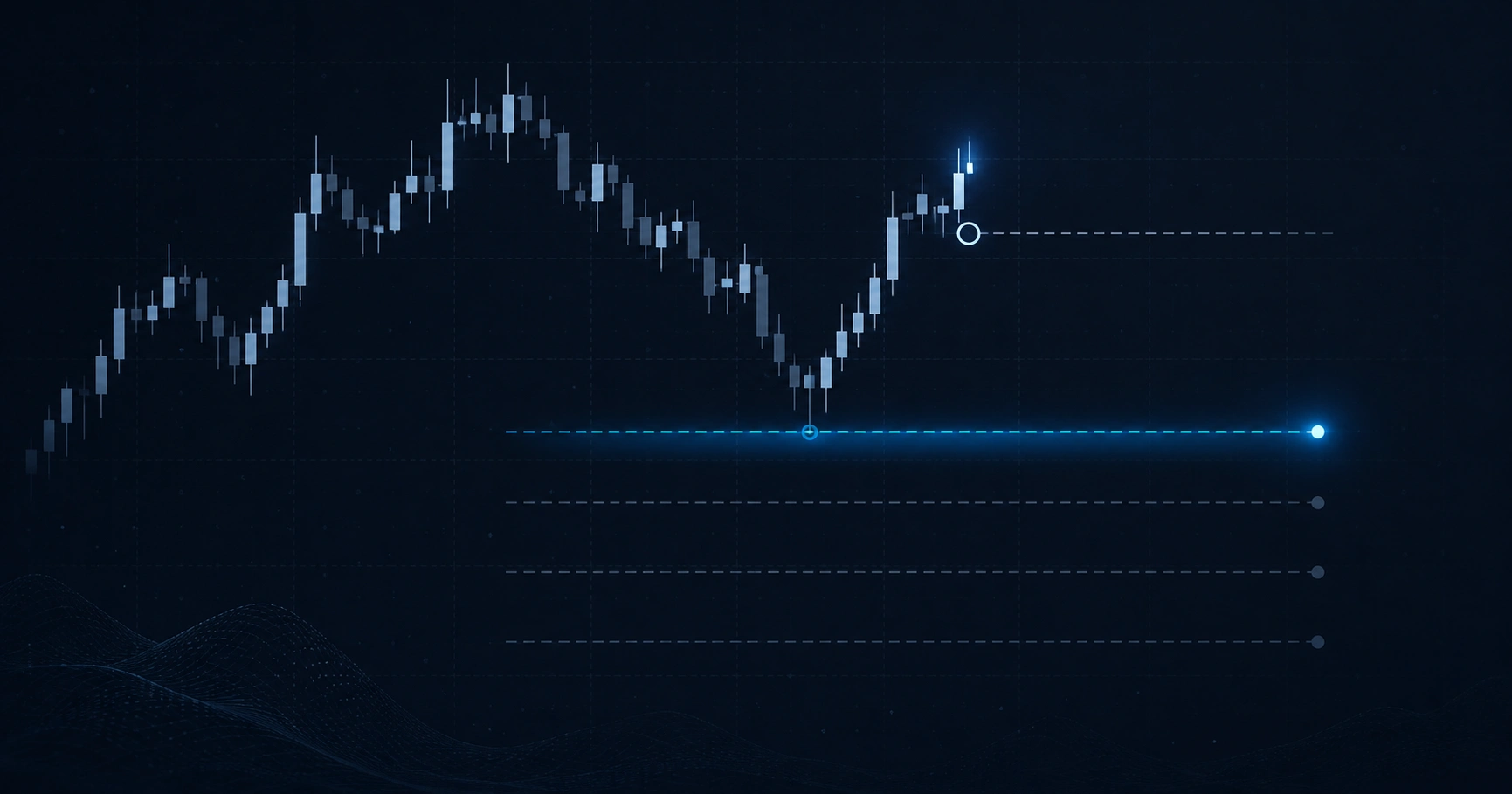
Place the stop beyond a level that would invalidate your reason for entering — below the swing low for a long, above the swing high for a short. This is logically coherent: the stop marks the point at which your thesis is disproven, not an arbitrary loss amount.
The drawback is that these levels are visible to everyone, and clusters of stops there are attractive targets. Placing the stop slightly beyond the obvious level, rather than exactly on it, is a common adjustment.
Volatility-based
Use Average True Range to scale the stop to current conditions — for example, entry minus 2×ATR. This adapts automatically: wider when the market is moving, tighter when it is quiet.
This is the most defensible general-purpose method, because it holds the probability of a random stop-out roughly constant across instruments and regimes.
Time-based
Exit if the trade has not worked within a defined period, regardless of price. Rarely used alone, but it addresses a real problem: capital tied up in a position going nowhere has an opportunity cost that price-based stops ignore entirely.
The trade-off that cannot be optimised away
A tighter stop means smaller losses and more of them. A wider stop means fewer losses and larger ones.
There is no setting that avoids both. What you can do is make the choice deliberately, and pair it correctly with position sizing — a wider stop must mean a smaller position, or you have simply increased your risk without noticing.
Two things worth avoiding
Round numbers attract order clusters, so stops sitting exactly at them are disproportionately hit. And moving a stop further away because price is approaching it converts a defined loss into an undefined one — which is the mechanism behind most catastrophic single-trade losses.
Educational content only. Not financial advice.
See the models in action
Reading about forecasting is one thing. Create a free account and get 5 AI predictions a month — no card required.
Start free