Swing Trading vs Day Trading
The choice is usually framed as a preference. It is closer to a decision about how much of your edge you are willing to hand to transaction costs.
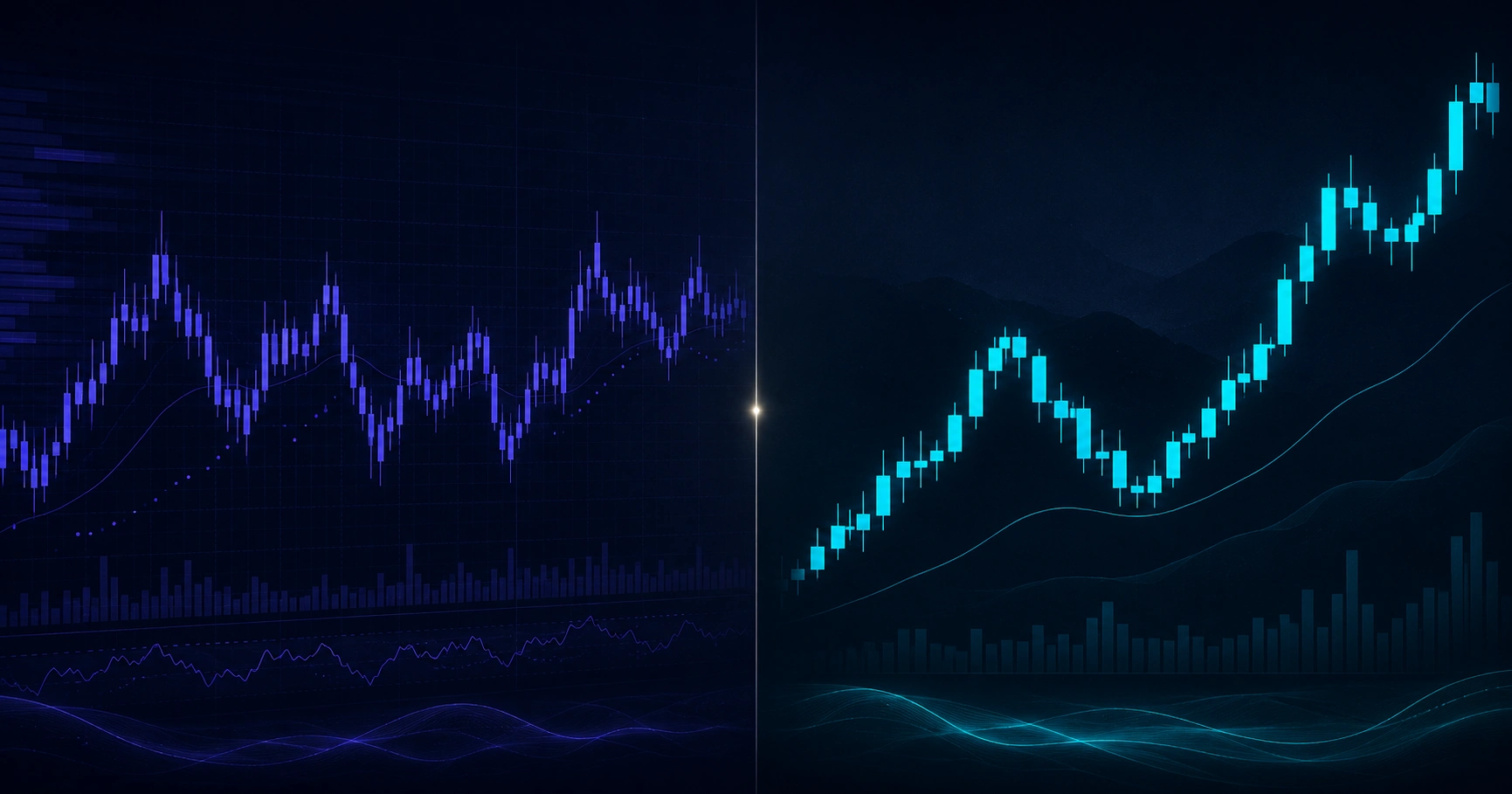
Day traders close positions before the session ends. Swing traders hold for days or weeks. The practical differences run deeper than holding time.
Transaction costs decide more than people expect
Every trade pays the spread and commission. A day trader taking five trades daily pays that cost roughly twenty-five times a week; a swing trader taking two positions weekly pays it twice.
If your edge is small — and most edges are — frequency determines whether costs consume it. This is the single strongest structural argument against high-frequency discretionary trading for retail participants.
Overnight risk
Day trading eliminates gap risk entirely. Swing traders accept it: news arrives when markets are closed, and price can open well past your stop level. On individual equities around earnings this can be severe.
The compensation is that swing trading captures moves that develop over days, which day trading structurally cannot reach.
Time commitment
Day trading requires continuous attention during market hours. It is a job. Swing trading requires a review that can take twenty minutes daily, often outside market hours.
For anyone with other employment, this is usually decisive — and attempting day trading while distracted tends to produce the worst of both approaches.
Noise versus signal
Shorter timeframes contain proportionally more noise. Intraday price is dominated by order flow, liquidity effects and algorithmic activity. Daily charts filter much of that out. There is more genuine signal per observation on longer timeframes, which is why the same indicator behaves more reliably there.
Shorter timeframes offer more opportunities and worse odds on each one.
The realistic assessment
Day trading is not impossible, but it competes directly with well-capitalised firms operating at speeds and costs individuals cannot match. Studies of retail day trading consistently find that the large majority lose money over time.
Swing trading is slower, less engaging, and involves gap risk. It also asks far less of your reaction speed and cost structure, which is why it is the more realistic starting point for most people.
Educational content only. Not financial advice. Trading involves substantial risk of loss.
See the models in action
Reading about forecasting is one thing. Create a free account and get 5 AI predictions a month — no card required.
Start free